85 % Feathers15 % Down
For those who want noticeable support: the high feather content gives the pillow body. The down adds some soft volume without overshadowing its feather-rich character.

Materials and technical terms
Material, blend, fill weight and ticking are different specifications. Here is what they mean.
Go to the glossary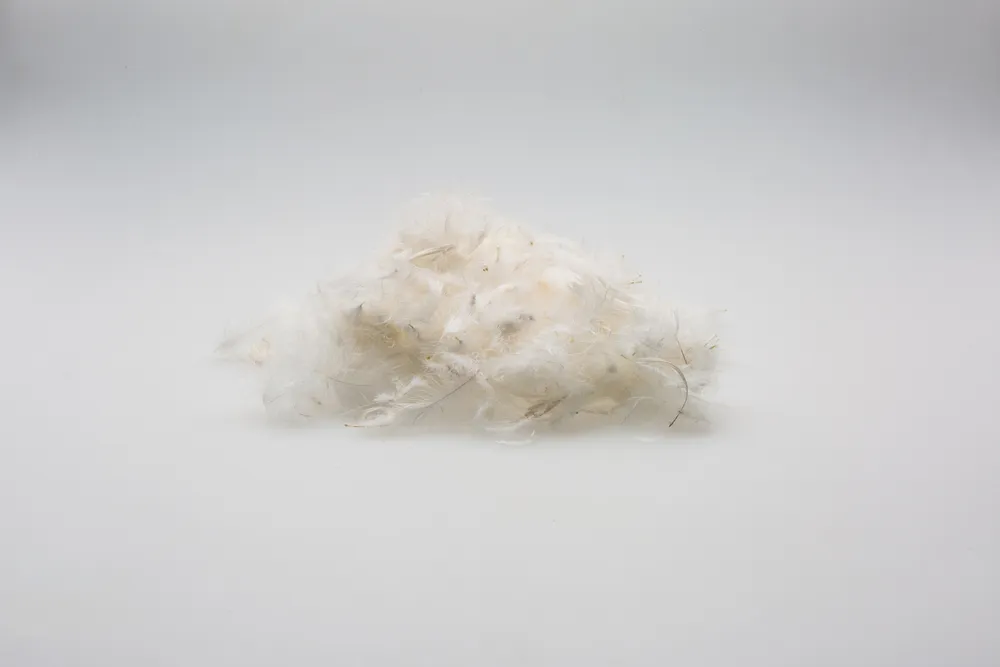
Feathers and down
The blend describes the proportions of the materials in a filling. For a pillow containing 85 % feathers and 15 % down, this does not yet tell you how much material is inside. That is shown on the product as the fill weight in grams.
Feathers provide support in the filling, while down adds soft volume. How this feels also depends on the size, casing and construction. A higher down content is therefore not a general recommendation for every use.
For those who want noticeable support: the high feather content gives the pillow body. The down adds some soft volume without overshadowing its feather-rich character.
If you want support together with a softer feel: feathers form the supporting base, while the greater down content makes the filling more yielding.
If you are looking for a soft, yielding pillow that still provides feather support: down adds airy volume, while feathers give the filling body.
For a particularly soft, yielding feel: light down volume takes centre stage. If you prefer firm support, a blend with more feathers is a more suitable starting point for advice.
These descriptions provide guidance rather than a fixed firmness rating. The height and firmness of your pillow also depend on fill quantity, size, casing and construction. We agree these properties with you for your specification.
How much material goes inside
One example from the PLUMA range is a pillow measuring 40 × 40 cm with 85 % feathers, 15 % down and a fill weight of 250 g. These specifications together describe the product.
The weight in grams alone is not a firmness rating. Always compare fill weight together with size, material and construction. If you do not yet know the required weight, describe the feel you want in your own words.
Understanding ticking
The name of the fabric and its weave describe different properties. Here you can see how the threads interlace.
70er Einschütte · 100er Einschütte
Warp and weft threads alternate over and under at each crossing, creating a closely interlaced fabric. 70er and 100er Einschütte share the same plain weave 1/1. The diagram does not represent fabric fineness.
70-grade fine twill
The interlacing points are offset in each row, creating diagonal lines. Fine twill ticking combines a supple feel with a durable fabric structure.
Satin · for comparison
Longer sections of thread lie on the surface and the interlacing points are distributed. This creates the smooth, silky sheen. Satin has a different weave structure from plain-weave or fine twill ticking.
The weave alone does not establish down-proofness. Fabric, finishing and filling are matched for each specification.
For reference
You will encounter the following terms when discussing pillows, duvets and your enquiry.
Care tips
Give pillows and duvets a good shake every morning when making the bed. This loosens the feathers and down and restores their loft.
Down and feathers benefit from one to two hours of fresh air by an open window or on a balcony. Strong sunlight makes down dry and brittle. Fog and rain are not good for feathers and down.
To remove dust and lint, occasionally brush the pillow or duvet with a soft brush. Do not vacuum or beat it.
Because of their volume, duvets are best taken to a commercial laundry or specialist feather bedding cleaner.
Pillows should be cleaned approximately every three years. Follow the washing temperature on the care label, usually 40 degrees, and use a mild detergent. This allows a pillow to be washed in a washing machine at home.
Do not hang on a washing line, as the filling may clump. Do not dry on or too close to a radiator or in strong sunlight. Please use a tumble dryer. If it switches off too early, put a damp towel in the drum. This signals to the sensors that the laundry is still damp.
Use the terms as a starting point. You can also simply describe your dimensions and ideas in your own words when making an enquiry.
Prepare an enquiry